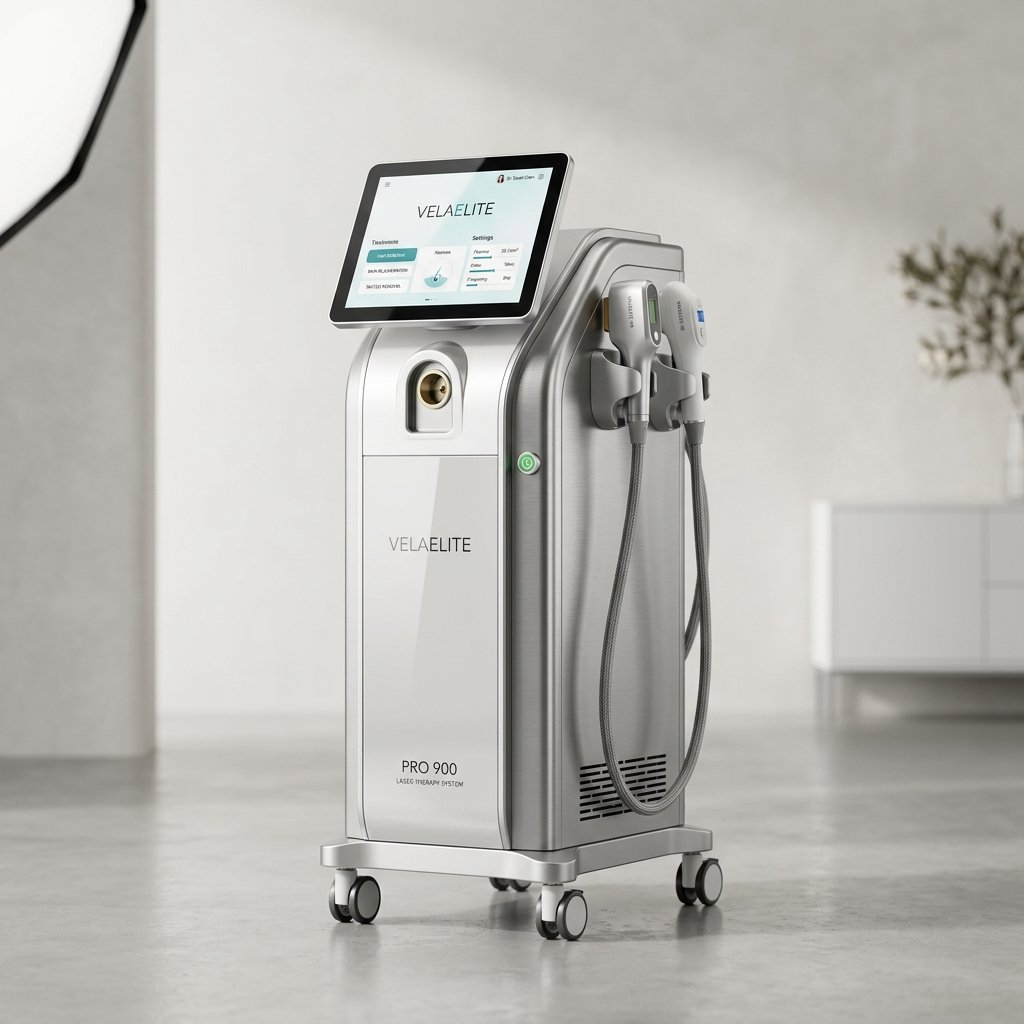
A clinic owner's guide to calculating ROI and payback on an aesthetic machine, with the formula, a worked example, hidden running costs, pricing strategy, and ways to reach break-even faster.
The return on an aesthetic machine is calculated by dividing your monthly profit from that machine (treatment revenue minus consumables, staff time, and running costs) into its total purchase cost, and the answer is the number of months until the machine has paid for itself. A machine that looks expensive can pay back quickly if it is well utilized, and a cheap machine can be a poor investment if it sits idle, so ROI depends far more on demand, pricing, and utilization than on the sticker price.
This guide gives you the formula, a worked example using placeholder numbers you can replace with your own, the costs clinics commonly forget, and the levers that shorten payback.
What every clinic owner should know before buying:
ROI for an aesthetic machine measures how much profit the machine earns compared with what you paid for it. Two numbers matter most: the payback period, which is how long it takes to recover the purchase cost, and the annual return, which is yearly net profit divided by investment. A machine that costs Rs 40 lakh and earns Rs 4 lakh net profit a month has a payback of 10 months and an annual return of 120%, before accounting for the fact that the machine keeps earning after payback.
Many marketing pages calculate payback using revenue alone. One typical example divides the machine price by the revenue from a six-session package and concludes that a handful of clients pays for the machine. That tells you when revenue equals cost, not when you have made money, because staff, consumables, rent, and marketing still need to be paid out of that revenue. Always calculate from net profit.
Calculate ROI in five steps, using your own market prices and costs:
Then: Payback months = Total investment / Monthly net profit.
The example below uses round numbers for illustration only, so replace every figure with your own quotes and prices before making a decision.
Illustrative assumptions:
Calculation:
Now test a pessimistic case. If you only book 20 sessions a month, revenue is Rs 4,00,000, variable costs are Rs 1,00,000, fixed costs are Rs 1,00,000, and net profit is Rs 2,00,000, so payback is 15 months. The same machine and the same price produce a very different result, which is why utilization is the number to stress-test before you buy.
Break-even sessions equal your total investment divided by the profit you make on each session, ignoring fixed costs for a first estimate. Using the example above, profit per session before fixed costs is Rs 15,000, so Rs 30,00,000 / Rs 15,000 = 200 sessions to recover the purchase cost. At 60 sessions a month, that takes a little over 3 months, and at 20 sessions a month, it takes 10 months.
Ways to estimate realistic session volume:
The most common ROI mistake is leaving out ongoing costs, so list every category before you trust a payback number.
Machines also differ in running costs. Some systems use per-treatment cartridges or tips, while others have no per-session consumable, so ask every supplier for a written list of recurring costs.

Payback speed depends on demand in your area, but machines with recurring, package-based treatments and broad client appeal usually recover their cost fastest. Hair removal and skin rejuvenation attract repeat clients, and multi-function platforms spread the cost across several treatments so the machine is rarely idle.
Explore Rohaan Traders machines for different business models:
If you are buying your first device, our guide on how to choose your first aesthetic machine explains how to match a machine to your client base, and our article on combination treatments shows how to increase revenue per client.
You should price treatments based on local market rates, your costs, and the value clients perceive, rather than copying a competitor blindly or discounting heavily to fill the diary. Underpricing lowers profit per session and lengthens payback, while overpricing leaves the machine idle.
Pricing strategies that support ROI:

You shorten payback by increasing utilization, raising revenue per client, and reducing downtime, and most of these actions cost little compared with the machine itself.
Proven levers:
ROI projections fail when they assume a full diary from day one, so check your own numbers for these common errors.
If the machine still pays back acceptably in the pessimistic case, the investment is far safer than one that only works when everything goes right.
After-sales support affects ROI because a machine that is out of service earns nothing while costs continue, so the speed of repair and the quality of training directly change your payback. Rohaan Traders backs every machine with a 1 year warranty, CE certified training, and 24/7 engineering support from Karachi and Dubai, so problems are handled quickly and your treatment calendar stays full. You can read about our service commitments on our after-sales page and learn more about the company on our about page.
Divide the total investment (machine, setup, and training) by your monthly net profit from the machine, which is treatment revenue minus consumables, staff time, and running costs, to get the payback period in months.
It depends on price, demand, and utilization, and well-utilized machines can pay back within months while underused machines can take well over a year, so always model a realistic and a pessimistic case.
No. Revenue is what you bill, while profit is what remains after consumables, staff, marketing, and overheads, and payback should always be calculated from profit.
Disposable tips and consumables, therapist training and time, servicing after warranty, marketing, financing interest, and the cost of downtime are the most common omissions.
A multi-function platform spreads cost across several treatments and reduces idle time, which often improves payback, but only if your clients actually want those treatments, so match the machine to your demand.
Yes, because reliability, training, and service response determine how much of the time your machine is earning, so evaluate the support package as carefully as the specifications.
Calculating the true ROI on an aesthetic machine before you buy protects your clinic from costly mistakes. Focus on realistic session volume, factor in all consumable and staff costs, and prioritize high-demand treatments backed by reliable after-sales support.
Want a payback estimate for a specific machine and your clinic's client base? Contact Rohaan Traders for a quote and a worked ROI projection, or browse our full aesthetic machine range.